
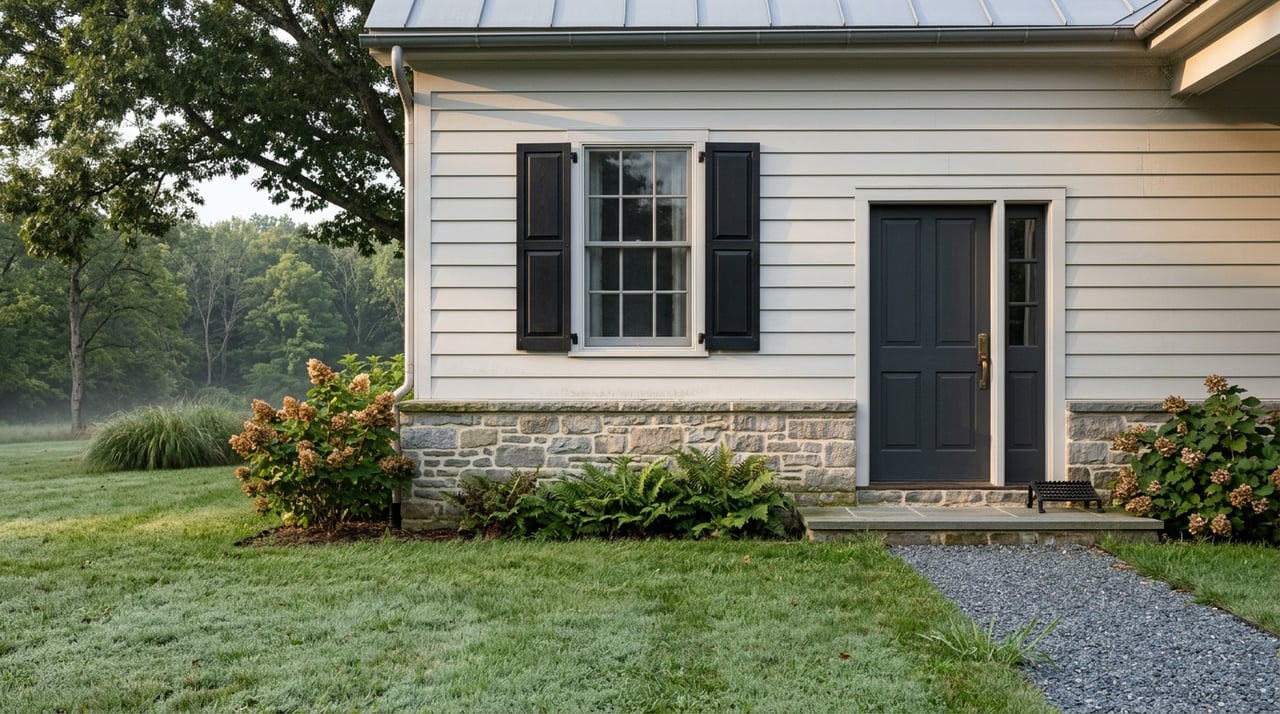
A property owner on a rural stretch of road north of Coatesville ran into a problem that had nothing to do with price or financing. The county had signed off on a new septic system for the lot, but that approval came with a condition: the new drain field needed a well at least 100 feet away, and the existing well didn't clear that distance. So a driller went out to sink a new one. Six hundred feet down, they hit nothing. No water, no viable well, just a hole that now had to be properly abandoned, on the owner's dime, while the original well stayed in service behind a UV disinfection unit as a workaround.
Nobody did anything wrong here. The county's setback rule is public information, the permit process worked as designed, and the driller followed standard practice. The problem is what most buyers assume going in: that because Chester County runs its well and septic program through a single health department, the rules feel uniform from one end of the county to the other. They don't. The permitting is centralized. The risk is not.
One office, most of the paperwork
The Chester County Health Department issues the permits for nearly everything involving private water and wastewater in the county: new septic installations, repairs, well construction, geothermal wells, even the monitoring wells used at contamination sites. It also enforces the state's Act 537 sewage rules when something goes wrong. That's genuinely useful to know if you're buying here after living somewhere with public water and sewer, because it means there's one department to call rather than guessing which office handles what.
Multiple sources that track septic regulation across the state single out Chester County, alongside Bucks County, as having a well-staffed environmental health operation with faster turnaround and a stricter read on setback rules than you'll find in less populated parts of Pennsylvania, where a single part-time Sewage Enforcement Officer might cover an entire rural county. That reputation for rigor is real, and it's earned. It's also easy to over-extend into an assumption that doesn't hold up at the closing table.
The permit comes from one office in West Chester. Whether you need an inspection to close comes from whichever township drew the line around your lot.
What's actually decided at the township level
Pennsylvania has no statewide law requiring a septic inspection when a home changes hands. That decision sits with each municipality, and it stays there even inside a county with unified permitting. Some Chester County townships have adopted point-of-sale inspection ordinances. Others haven't. Franklin Township, for example, has a standing ordinance governing municipal management of on-lot sewage disposal facilities, spelled out in its own code. A township three miles away may have no equivalent requirement on the books at all.
Here's the practical split:
| Handled countywide | Handled by your specific township |
|---|---|
| New system and well permits | Whether a point-of-sale inspection is required |
| Enforcement of Act 537 violations | Local pumping frequency mandates |
| Well and septic site evaluations | Municipal sewage facilities planning updates |
Chester County also runs a mandatory pumping and inspection program specifically in areas with documented groundwater contamination, which is a countywide layer on top of whatever the township already requires. So a buyer can be right that Chester County takes this seriously and still be wrong about what that means for their specific address. The only way to know for certain is to ask the township, not the county, whether a transfer triggers an inspection.
Why getting it wrong costs more here than almost anywhere else in the state
If a system does fail inspection, the price of fixing it in Chester County is not the statewide number you'll find in a general guide. As of 2026 cost data, a standard 1,000-gallon conventional system with a typical drain field runs somewhere between $16,000 and $20,000 to install here, compared to $10,000 to $14,000 for a comparable system in rural Centre County.
The reason is soil, not bureaucracy. Southeastern Pennsylvania's clay-heavy ground and higher water tables push more properties into engineered systems, sand mounds instead of simple gravity fields, which cost more to design and build. As of 2026, Chester, Montgomery, Delaware, and Bucks counties together run 20 to 35 percent above the Pennsylvania average for septic work. That gap matters most at exactly the moment a buyer doesn't want surprises: after an inspection contingency turns up a problem and the negotiation over who pays begins.
Wells carry their own version of the same story. Southeastern Pennsylvania sits on Piedmont crystalline bedrock, and wells drilled through it commonly reach 150 to 350 feet, deeper than the 75 to 200 foot wells common in the limestone regions of central Pennsylvania. Deeper wells cost more to drill and more to abandon if they come up dry, which is exactly what happened north of Coatesville.
The setback rule that turns one problem into two
That case illustrates a mechanic worth understanding before you make an offer on a property with both a well and a septic system: Pennsylvania's minimum setback is 100 feet between a well and a septic component, and some townships require more. On a smaller or oddly shaped lot, meeting the septic requirement can force the well into a location where water simply isn't available, or into ledge rock that makes drilling expensive before you even hit the 600-foot mark. A septic problem and a well problem are often the same problem wearing two different permits, and it usually doesn't show up until a soil evaluation or a septic repair triggers a second look at the well's location relative to the new field.
What to ask before you write an offer
If a property outside one of Chester County's boroughs, in communities like Chester Springs, Exton, or unincorporated stretches of Franklin Township for example, runs on a private well and on-lot septic system, a few questions early in the process save real time later:
- Is there a current, permitted septic system on file with the Chester County Health Department, and when was it last inspected or pumped?
- Does the specific township require a point-of-sale septic inspection, and if not, will the buyer's lender require one anyway? FHA and VA financing almost always do.
- What type of system is it, conventional gravity, sand mound, or aerobic treatment unit? Aerobic units carry ongoing maintenance contracts and quarterly inspection requirements that a buyer needs to budget for after closing.
- What is the well's tested yield, and does it clear the minimum of 100 gallons per bedroom plus 100 gallons within two hours that lenders typically look for?
- Has the water been tested for more than bacteria and nitrates? Homeowners in Chester Springs and Exton commonly report hard water and iron in their well water, and USGS groundwater modeling for the county shows a small but real arsenic exceedance rate across the area, which is a reason to ask for a fuller panel than the bare minimum.
If you're selling, sequence beats speed
The strongest position for a seller with a well or septic system is to get ahead of the questions above rather than answer them under contract pressure. A pre-listing inspection through a PSMA-certified provider, and Chester County has several, including Chester County Septic, LLC, typically costs a few hundred dollars and gives you time to fix a cracked baffle or schedule an overdue pump-out before a buyer's inspector finds it first. Chester County Home Inspections and similar local providers can bundle a septic evaluation with a water quality test and well certification in a single visit, which is often faster than coordinating three separate appointments once you're already under contract.
A few common questions
Does every Chester County municipality require a septic inspection to sell a home? No. It's decided township by township, and the county's own strict reputation doesn't mean every municipality has adopted a point-of-sale ordinance. Ask the local Sewage Enforcement Officer directly.
If my township doesn't require an inspection, can I skip it? You can, but most lenders won't let you. FHA and VA loans require proof the septic system functions and that well water meets safety standards, regardless of what the township mandates.
Is a passing water test a one-time thing? Pennsylvania doesn't regulate private well water after the well is drilled, so a passing result at closing tells you the water was safe that day. Annual testing for bacteria and nitrates is the standard recommendation for anyone living on a well long term.
A well and septic system can be the best financial decision on a rural Chester County lot or the reason a closing gets delayed by weeks. The difference usually comes down to who asked the right question three miles before it mattered. Next Move Delaware Valley works these townships regularly and can tell you before you write an offer whether your specific address falls under a point-of-sale ordinance, what a realistic repair budget looks like if the system needs work, and how to sequence an inspection so it doesn't stall your deal. Let's find home.