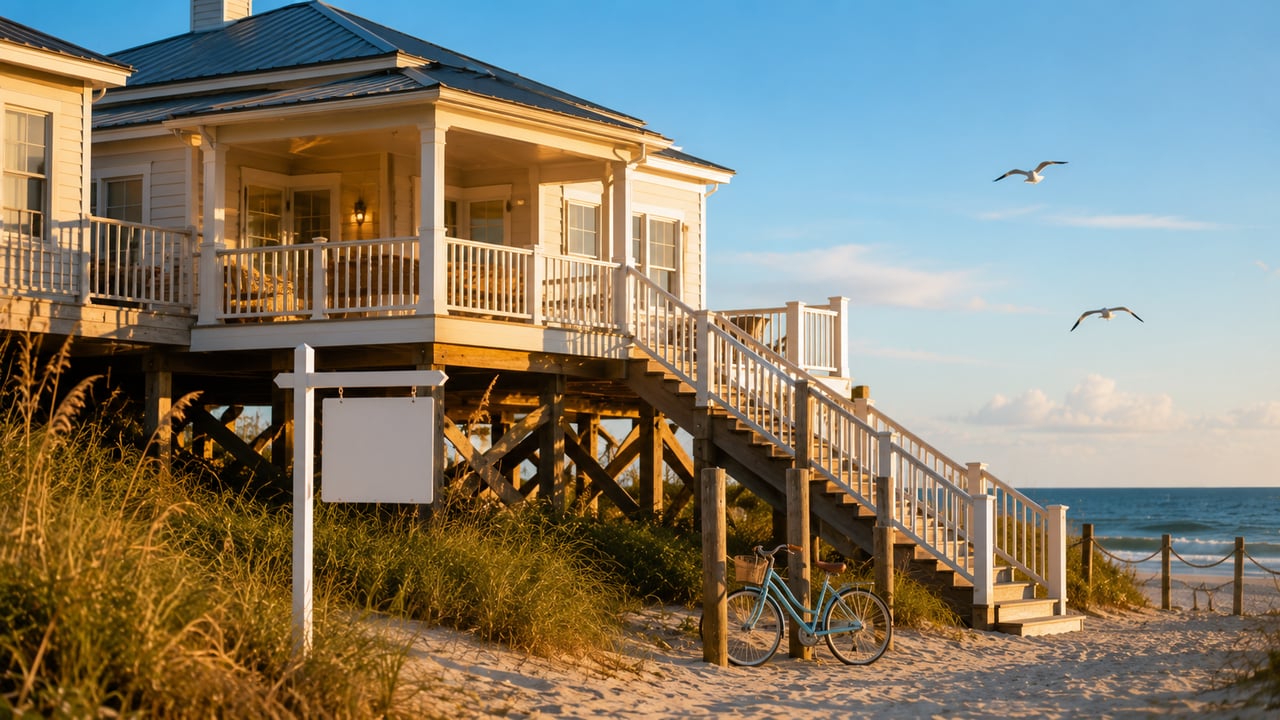
A beach house at the Delaware shore is a dream for a lot of people. But is it actually a smart investment in 2026?
The honest answer: for the right buyer, yes — and the timing this year is unusually favorable.
But a beach house is part financial decision, part lifestyle decision, and the smartest buyers look hard at both. Let's dig into the real 2026 numbers, the rental income potential, and the true costs — so you can decide with clear eyes.
📊 The 2026 Market: A Buyer's Window
Here's the headline every beach buyer should know: for the first time in years, coastal Delaware has shifted into a genuine buyer's market.
The Sussex County data as of 2026 tells the story:
✔️ The county median sold price is around $440,000, down roughly 3.3% year-over-year
✔️ Inventory sits near 2,500 active listings — more than any other Delaware county
✔️ Days on market are up sharply, roughly 40% over the prior year
✔️ Buyers are routinely closing at about 88 cents on the dollar versus asking
Importantly, this is a rebalancing, not a crash — most experts describe 2026 as a stabilization phase, not a collapse. And remember: that county median includes lots of inland homes, so the actual beach towns run higher.
🏖️ What Beach Homes Actually Cost
Prices vary widely by town, which means there's an entry point for many different budgets:
✔️ Lewes — the mid-$500,000s to $700,000s see the most activity; a stable, year-round community popular with retirees
✔️ Rehoboth Beach — the most vibrant market, with single-family homes around $800,000 and ocean-block properties well past $1.5 million; condos offer more attainable entry
✔️ Bethany Beach & Fenwick Island — oceanfront and ocean-block single-family homes top $1 million, with entry-level condos starting in the $600,000s; among the most stable sub-markets
✔️ Ocean View and inland towns — more space and lower prices, often in the $500,000s
The takeaway: you don't have to buy on the boardwalk to own a slice of the Delaware coast.
💵 The Rental Income Opportunity
For many buyers, rental income is what makes the math work.
Sussex County draws millions of visitors every summer, and well-located properties — especially those within walking distance of the beach or in communities that allow short-term rentals — can generate roughly $30,000 to $80,000 or more in annual rental income, depending on size, location, and amenities.
Here's why 2026 is compelling: softened purchase prices combined with strong, steady rental demand can meaningfully improve your return profile. You may be able to acquire a well-positioned rental at a realistic price — something that was far harder during the frenzy of 2021 and 2022.
It's also worth remembering that no state sales tax gives Delaware rentals a quiet edge: everything from new appliances to furniture packages to renovation materials costs less to buy, which lowers your setup and turnover expenses year after year.
One critical caveat: always confirm a community's HOA rules before buying, because some planned communities restrict or prohibit short-term rentals. And budget for Delaware's lodging tax and local rental licensing.
📈 The Bull Case: Why It Can Be Smart
Several durable fundamentals support beach real estate as a long-term investment:
✔️ Scarcity. The coast has a finite amount of developable land, which keeps a floor under home values.
✔️ Delaware's tax advantages. No sales tax (a real savings on furnishing, renovations, and maintenance), low property taxes, and no estate or inheritance tax.
✔️ Powerful demand drivers. A wave of retirees from higher-cost Northeast states, remote-work flexibility turning beach towns into year-round communities, and easy access from Philadelphia, New Jersey, D.C., and Maryland.
✔️ Relative value. Coastal Delaware remains more affordable than many other East Coast beach markets.
Recent appreciation has been steady and sustainable — generally in the mid-single digits year-over-year in the beach towns — the kind of growth that builds long-term wealth without bubble risk.
⚠️ The Costs & Risks: Be Honest
A smart investment analysis means looking at the downsides, too:
✔️ Higher costs of ownership. Flood insurance (and flood-zone status), elevated coastal homeowners insurance, and extra maintenance from salt air all add up.
✔️ Seasonality. Rental income is concentrated in the summer, so cash flow isn't evenly spread across the year.
✔️ Short-term softness. Prices are down modestly year-over-year, and homes are taking longer to sell.
✔️ It's a lifestyle asset first. Pure appreciation returns are typically modest — this is not a quick-flip market. It rewards long-term owners, not speculators.
None of these are dealbreakers. But they're essential to factor into your numbers before you buy.
🧮 How to Tell If It's Smart for You
The right answer depends entirely on your situation. Before buying, weigh your true, all-in picture:
✔️ Total costs — purchase price, financing, property taxes, insurance, maintenance, and HOA fees
✔️ Realistic income — conservative rental projections, minus vacancy, management, and taxes
✔️ Personal-use value — how much you'll enjoy and use the home yourself
✔️ Your timeline — beach real estate rewards long holding periods, not short ones
If the numbers work with conservative assumptions — and you love the idea of owning at the shore — a beach house can be both a sound investment and a lifestyle win.
🔑 Smart-Buyer Tips for 2026
To make the most of this rare buyer-friendly window:
Use Your Negotiating Leverage
With sellers asking well above what buyers are paying, there's real room to negotiate — don't overpay.
Get Submarket-Specific Data
County averages can mislead. Insist on neighborhood-level comparables for the exact town and community you're targeting.
Verify Insurance and Flood Zones First
Get flood-zone status and insurance quotes before you make an offer — they can dramatically affect your costs.
Confirm Rental Rules and Get Pre-Approved
Check HOA short-term-rental policies, and line up second-home or investment financing early, since it differs from a primary-home loan.
Final Thoughts: The Verdict
So, is a Delaware beach house a smart investment in 2026?
For long-term, lifestyle-minded buyers who do their homework, it may be one of the best windows in years. You get genuine negotiating leverage today, combined with durable long-term demand, scarcity, and Delaware's unbeatable tax advantages. And with many forecasters expecting demand to pick back up if interest rates ease, the current buyer-friendly conditions may not last forever — which is exactly why preparation beats waiting.
Just go in clear-eyed: know your all-in costs, verify the rental rules, buy for the long haul, and don't count on a quick flip.
Do that, and a Delaware beach house can deliver something rare — a sound financial move and a place your family will treasure for generations.
This article is general information, not financial, tax, or legal advice. Every situation is different — please consult your own financial, tax, and legal professionals, and do your own due diligence before investing.
If a beach home might be your next move, the smartest first step is a no-pressure conversation about your goals, your budget, and the numbers that matter. 🏖️🏡
🏡 Your Next Move Starts Here.
Jim Arcidiacono, REALTOR®
Next Move Delaware Valley | KW Empower
Licensed in PA • DE • MD | Nationwide Referral Partner
🌐 www.delawarevalleyrealestate.com